What if Asimov left us a solid “stress test” for AI in 2026?
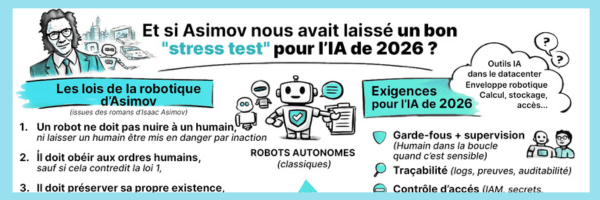
A useful reminder: Isaac Asimov's laws of robotics are not legal statutes. They are a fictional framework (from the 1940s onward, the Robot cycle) devised to explore ethical dilemmas.
The “classic” three laws, in short:
- a robot may not harm a human, nor through inaction allow a human to come to harm,
- it must obey human orders, unless doing so conflicts with the first law,
- it must protect its own existence, unless doing so conflicts with the first two laws.
Asimov later added a Zeroth law that changes the scale: 0) a robot may not harm humanity, nor through inaction allow humanity to come to harm.
And there lies the heart of the problem: protecting an individual versus protecting the collective… who decides what “humanity's interest” is? At what price? With what legitimacy?
Except that today, our “robots” are no longer mechanical arms. They are AI models running in datacentres. And the datacentre has become their robotic body: compute, storage, network, access to tools — and therefore the ability to act.
In very concrete terms for 2026: the question is not only “what does the model answer?” but “what do we allow it to do, on which data, with which rights, and with what proof?”
If we “translate” Asimov into engineering requirements:
- guardrails and supervision (a human in the loop whenever it matters),
- traceability (logs, evidence, auditability),
- access control (IAM, secrets, approved connectors, least privilege),
- recovery capability (limits, rollback, kill switch),
- sobriety (the “body” has a cost and a footprint: FinOps/GreenOps).
A question for you: in your organisation, is the real 2026 issue security, compliance, sobriety… or business transformation?
Written by Jawaher Allala — Contact us