
Data governance,
made executable
and provable.

Systnaps builds Data Recycling®, the operational data-governance platform that helps CIOs, Data, Risk and Compliance leaders master, reduce and unlock their data estate.
Built for data decision-makers
- CIO
- CDO & Data teams
- DPO
- CISO
- Risk & Compliance
- Architecture leads
Labels, awards & partners



 Innovative player


They industrialize their data governance with Systnaps



Data has become
a liability for your organization
Today, six tensions turn a strategic asset into cost, risk and a brake on transformation.
Regulatory pressure and audit burden
Depending on your sector and use cases, the requirements of the GDPR, NIS2, DORA, the Data Act and the European AI Act keep tightening and overlapping.
The tension
declared policies are no longer enough. You must continuously demonstrate what was decided, executed and validated.
Exploding volumes, costs and footprint
Redundant, obsolete, trivial or unused data ties up storage, backup, energy and controls without producing any value.
The tension
their accumulation increases costs, the exposure surface and the environmental footprint of the information system.
Loss of business trust
Duplicates, conflicting definitions and outdated data undermine indicators and decisions.
The tension
teams reconcile figures instead of acting, multiply manual checks and end up doubting their own dashboards.
Architectural complexity and technical debt
Cloud, SaaS, ERP, CRM, files and legacy applications multiply silos, dependencies and heterogeneous models.
The tension
technical teams maintain fragile pipelines instead of modernizing the IS and accelerating transformations.
Stalled data and AI projects
Data and AI projects require qualified, traceable, contextualized data that can be used under controlled conditions.
The tension
without solid governance, every project restarts data preparation, moves slowly and delivers results that are hard to make reliable or industrialize.
Unmanaged data lifecycle
For lack of clear, executable rules, data is kept "just in case", with no decision actually applied to all of its representations.
The tension
the organization no longer knows precisely what it must keep, archive, anonymize, reuse or destroy — nor how to prove it.
A catalog describes your data.
Data Recycling puts it under control.
For every contract, invoice, customer, claim or file in its value stream, Data Recycling creates an ODOM (Operational Data Object Model): an operational twin that links the business object to its data, rules, uses, lifecycle actions and evidence.
Understand
Link business objects to their data, applications, processes, responsibilities and relations.
Govern
Attach rules, classifications, retention periods, trust levels and decisions.
Act & prove
Run quality, archiving, anonymisation, purge or reuse, then produce the proof.
Data managed as
a resource
Systnaps applies circular economy principles to data management. Reduce useless data, leverage valuable data, control the full lifecycle.
Turning data chaos into a trusted resource.
The engine of data circularity
The ODOM links every business object to its data, uses, rules and evidence. It tells you what to keep, cleanse, reuse, archive or delete, then proves the action was carried out.
It turns an isolated piece of data into a governed business object across its entire lifecycle. Within a single operational twin, it represents:
- what the data means to the business;
- where it exists and how it flows;
- which rules apply;
- which actions must be taken;
- what was actually executed;
- what evidence was produced.
The Operational Data Object Model automatically discovers your data structures, maps your IT landscape in real time and translates the technical into business language — no development, no code.
Industrialize governance
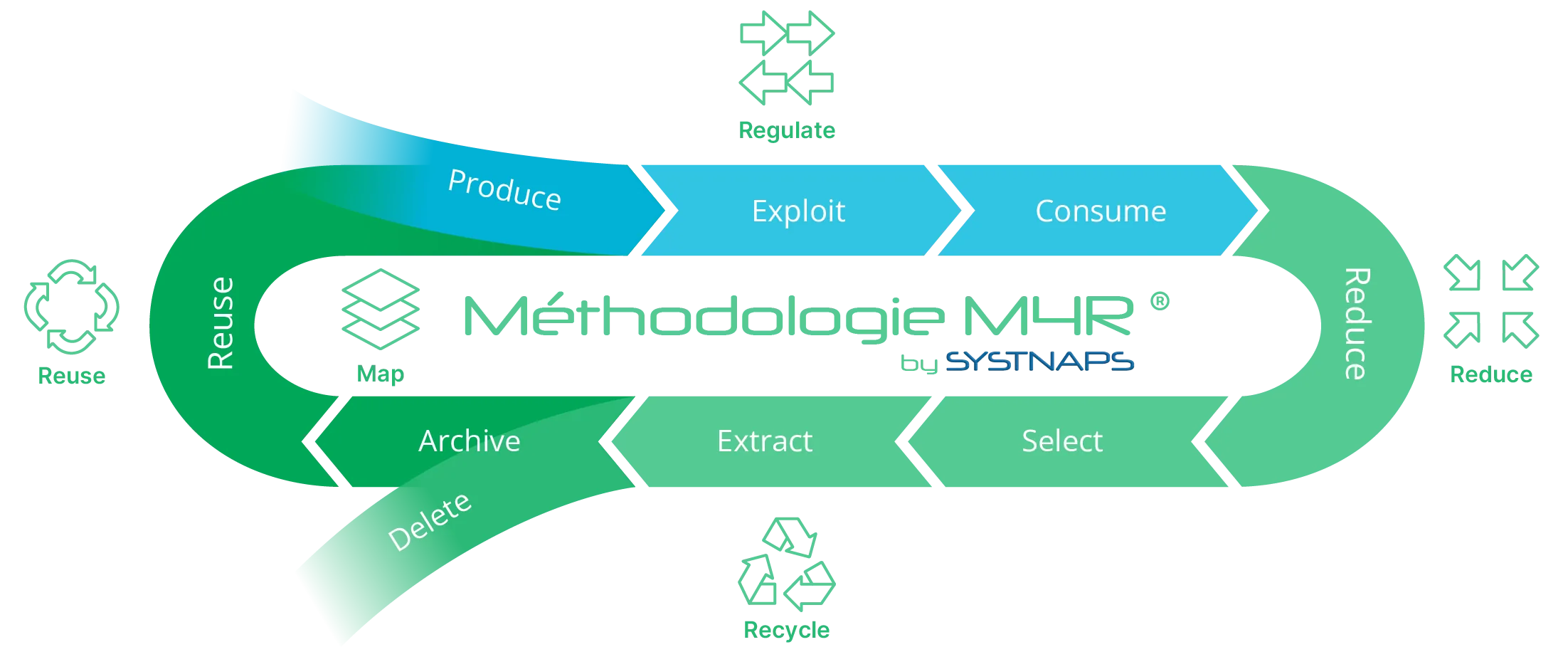
with the M4R® method
A structured five-step approach to control your data's full lifecycle — the circular economy applied to data.
One product core.
Journeys for your priorities
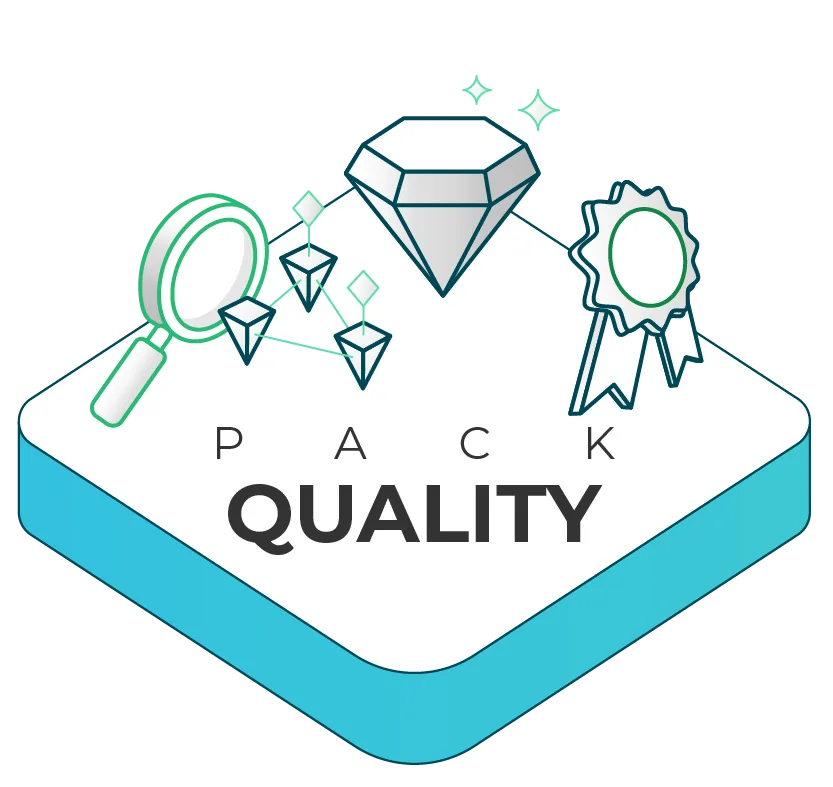
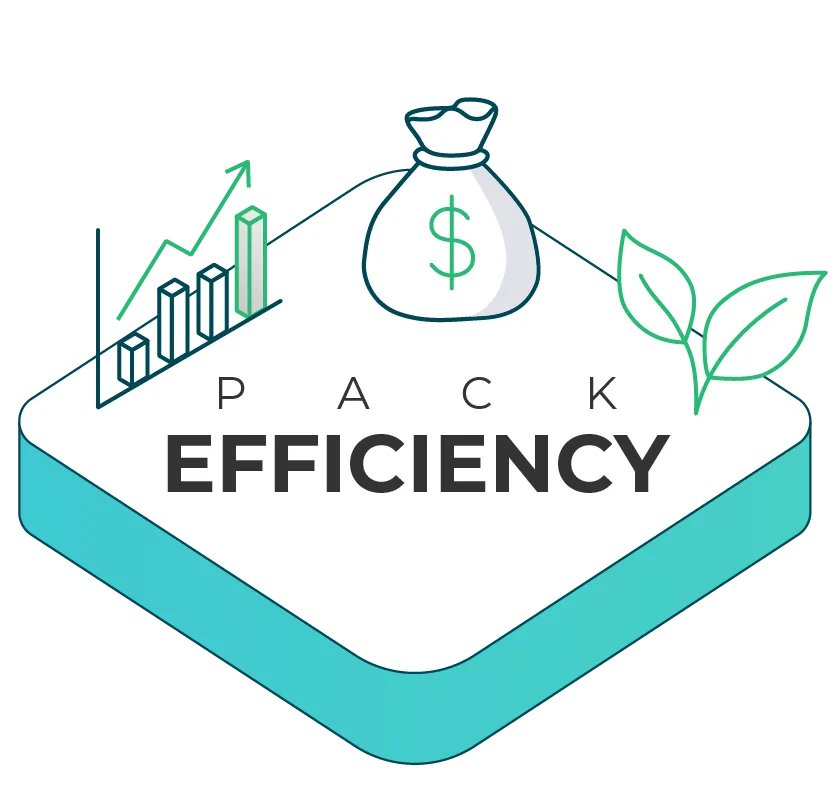
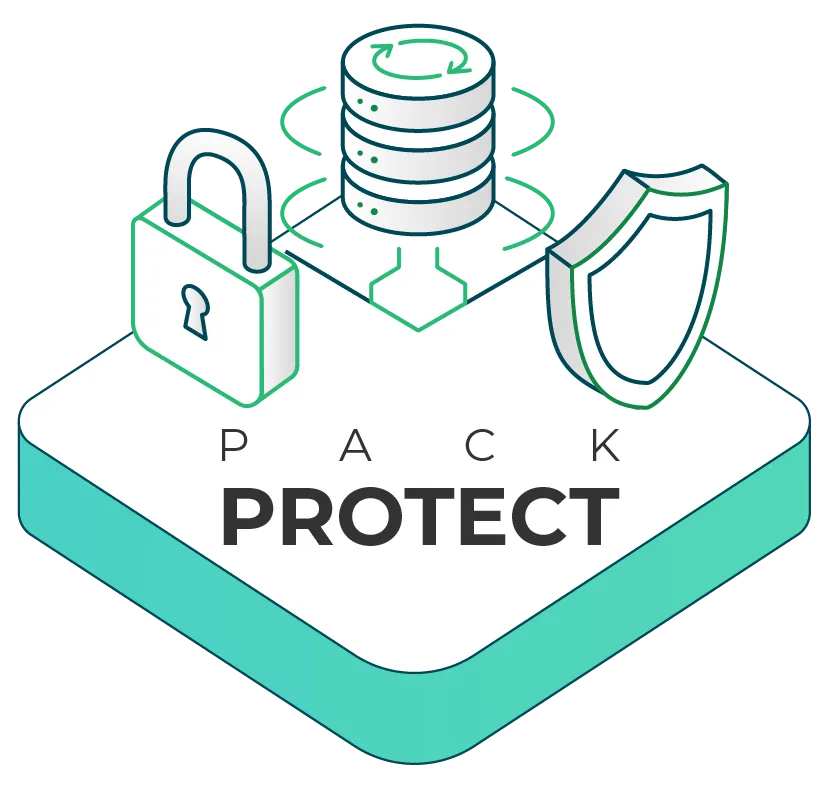
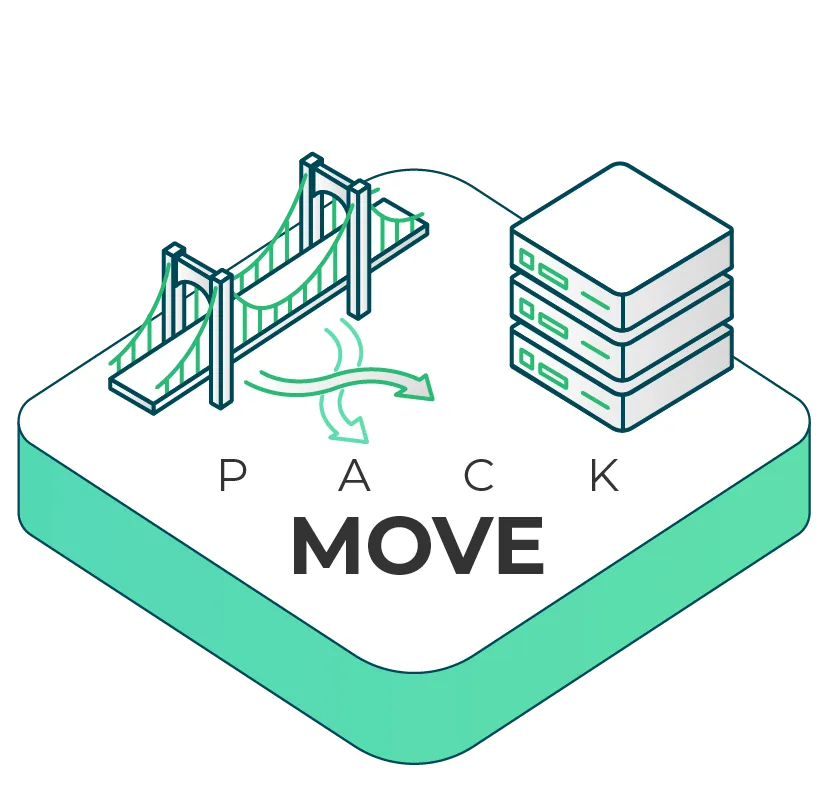
Data Mastery is the foundation — map, structure and govern the data estate. The other packs are journeys you activate by priority.
Data Mastery
Put data governance under control with a shared framework and joint business/IT steering.
Evidence
Centralize evidence, formalize policies and strengthen your data governance for audits.
Concrete results
for your organization
Evidence, not promises. Every figure comes from production projects at our clients.
Four measurable benefits
- IT cost reduction — storage, infrastructure, licenses. Up to −40% from the first campaign.
- Regulatory risk control — enforceable Evidence Packs, full traceability, CNIL and ANSSI audit-ready.
- Faster AI projects — qualified data, deduplication and masking for audit-ready ML pipelines.
- Smaller digital footprint — Solar Impulse Efficient Solution and GreenTech Innovation labels.
Reliable AI starts with
a data estate under control
An AI agent must not only access a piece of data. It must understand its context, its purpose, its relationships, its quality, its sensitivity and the conditions under which it may use it.
Data Recycling prepares the governed, actionable and proven context that AI can reason and act on. Not "better AI than the rest" — the foundation of trust they require.
CIOs who took back control
Systnaps gave us a clear representation of our system and data model, including our historical customizations.
Beyond innovation, there is an obvious economic benefit. We went from 2,500 to 1,400 days — a 40% saving.
Dassault Systèmes has used Systnaps for years. Every project is productive; our 60 business units are optimized.
Everything you ask us
Is Data Recycling® a Data Catalog?
No. A Data Catalog mainly describes data and its metadata. Data Recycling® links business objects to their data, uses, rules and lifecycle — so you can understand your application data estate through reverse-documentation, then qualify, correct, protect, archive, anonymise, move or delete it, and produce evidence of the actions taken.
What is the ODOM?
The ODOM is the operational twin of a business object (an automated, meaningful data model): contract, invoice, customer, claim or case. It links that object to its applications, data, flows, rules, owners, lifecycle actions and evidence.
What is the M4R® method?
M4R® is a proprietary Systnaps methodology that applies the principles of the circular economy to data:
- Map: understand and map;
- Regulate: apply the rules;
- Reduce: reduce volumes, defects, costs and risks;
- Reuse: reuse data with confidence;
- Recycle: manage its lifecycle.
An organisation can start with its highest-priority challenge and progress scope by scope.
Where should we start if our estate is poorly documented?
Start with a priority scope: an application, a database, a flow, a document repository or a business object. Data Recycling® reverse-documents the existing system to rebuild structures, metadata, dependencies, flows and observable rules. These results are then matched to business uses, validated and enriched by the teams. You get a usable first map without waiting for perfect documentation or launching an exhaustive inventory of the whole organisation.
Does the mapping stay up to date over time?
Yes. Data Recycling® doesn’t produce a one-off document destined to become obsolete. Models are versioned and observation campaigns can be run regularly. The platform detects changes in structures, flows, rules or dependencies and keeps knowledge of the estate current over time.
How does Data Recycling® improve data quality?
Quality is assessed in the context of the business object and its use. Data Recycling® lets you define and run completeness, consistency, accuracy, uniqueness or timeliness checks, then track anomalies and the corrections made. Quality is part of the REDUCE approach: reduce errors, duplicates, inconsistencies and non-compliance risks before reusing the data.
How does Data Recycling® prepare data for AI?
Data Recycling® helps identify available data, its origin, quality, traceability, usage restrictions and business context. Data and AI projects can then rely on better-qualified, governed data, without restarting their search and preparation for every new project.
How does the solution reduce non-compliance risks?
Data Recycling® links requirements to the relevant assets, then to the controls and actions to carry out. The platform helps identify sensitive data, over-retention, uncontrolled copies, quality defects or insufficient protection. Correction, protection, archiving or deletion actions can then be tracked and documented.
Can you prove a rule was actually applied?
Yes. Data Recycling® keeps the full chain: applicable rule, scope concerned, decision, action executed, result and validation. These are gathered in an Evidence Pack usable during an audit, an inspection or an internal review.
How do you handle archiving, anonymisation and deletion?
Data Recycling® lets you define complex lifecycle rules and identify every representation concerned: applications, databases, files, document repositories or test environments. The platform can orchestrate the appropriate actions — archiving, anonymisation, masking, moving or deletion — then check the result and manage any exceptions.
How does Data Recycling® support a migration or decommissioning?
The solution maps dependencies, distinguishes useful data from data that can be archived or deleted, prepares the mappings and checks the results after transformation. This avoids carrying useless volumes, errors and historical debt over to the new system.
Does our data have to be copied into Data Recycling®?
No. Data Recycling® favours processing directly at the source, as close as possible to the systems where the data lives. The platform collects the metadata and results needed for governance without creating useless copies of business data. This reduces transfers, storage needs, data exposure and resource consumption.
Why process data directly at the source?
Acting at the source improves performance and avoids moving large volumes to an intermediate platform. This approach helps to:
- reduce duplication;
- limit transfers;
- better control access;
- lower storage and compute needs;
- produce evidence closer to actual execution.
Can Data Recycling® be deployed without exposing our data?
Yes. Data Recycling® is built on a hybrid architecture that keeps sensitive processing within the client’s controlled environment: on-premise, private Cloud or edge depending on the project. Data stays in authorised systems and operations can run locally. Data Recycling® provides governance, observability, orchestration and evidence without forcing centralisation of the estate. Data Recycling® is a proprietary, sovereign solution developed by Systnaps.
Does Data Recycling® replace our existing tools?
No. Data Recycling® connects to the systems already in place: business applications, databases, files, data platforms, storage, Cloud environments and governance tools. It adds a common layer of context, rules, execution, observability and evidence across these environments.
Do we need a large team?
No. A first scope can be launched with a small team: a business owner, a Data or IT representative and, depending on the topic, the DPO, the CISO or Compliance. In smaller organisations, several roles can be held by the same people.
How long does it take to get a first result?
The timeframe depends on the scope, access to sources and the depth expected. The recommended approach is to start with a priority application or business object to quickly obtain a first reverse-documentation, a usable map, measured gaps, an action plan and the first evidence.
What is the Data & AI Diagnostic offered by Systnaps?
The Data & AI Diagnostic assesses your organisation’s ability to master, improve and leverage its data, especially for its artificial-intelligence projects. From interviews, an analysis of your practices and a representative scope, Systnaps identifies:
- priority data, applications and uses;
- quality, traceability or accessibility issues;
- security, compliance and over-retention risks;
- barriers to industrialising Data and AI projects;
- the highest-value use cases;
- priority actions and the associated roadmap.
The deliverable includes a status assessment, a maturity evaluation, reasoned recommendations and a first experimentation scope. The diagnostic isn’t about finding an AI use case at any cost: it first checks that the problem is properly framed and that the required data can be used under reliable, secure and controlled conditions.
How much does it cost?
The Data & AI Diagnostic represents an investment of €10,000 excl. VAT. It can be financed up to 40% by Bpifrance, subject to eligibility. Remaining cost for an eligible company: €6,000 excl. VAT.
What is the first step?
You can start with the M4R® maturity diagnostic or by scoping a first perimeter: application, business object, migration, sensitive data, quality, storage costs or AI readiness.
Take back control of
your data estate.
30 minutes, a Data/AI assessment, and first results within 24 hours. Eligible for BPI France funding.
European sovereignty · Sovereign cloud or on-premise · Eco-designed
Let's talk about your
data estate.
A question, a project, an assessment? We reply within 24 business hours.