The next competitive advantage will be proof
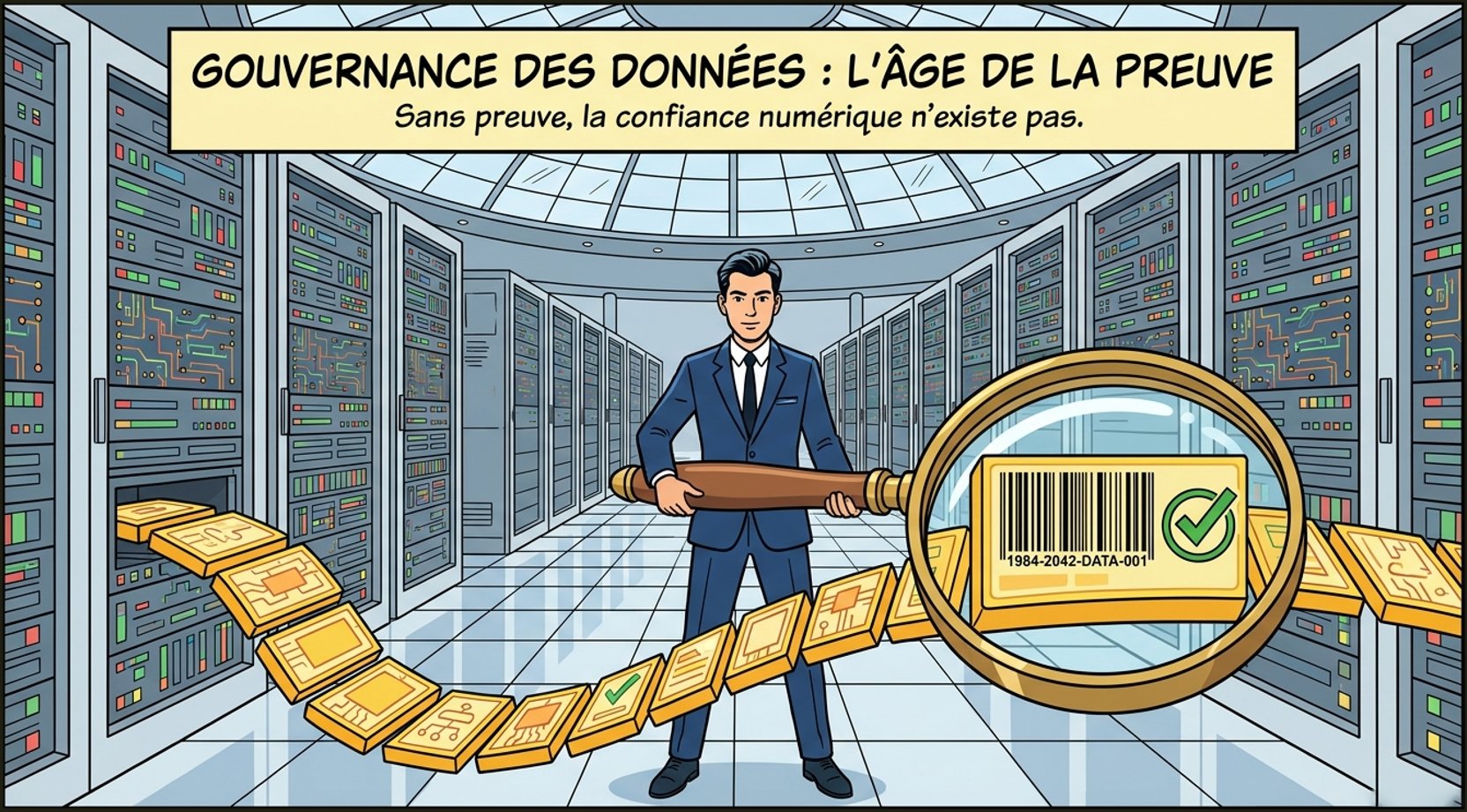
Artificial intelligence has exposed a reality that many organisations long underestimated: it is no longer enough to claim that you master your data. You must now be able to demonstrate it. At a time when every piece of data may feed a strategic decision, an AI model, a regulatory audit or a risk analysis, declarative governance is reaching its limits. Companies are gradually entering a new era: governance by proof.

For many years, data governance programmes were built around charters, internal policies, committees, business glossaries and data catalogues. These instruments established a framework and spread a data culture.
Yet they also sustained a common confusion: assuming that documented data is automatically data under control.
Operational reality is often different. An organisation may have exemplary governance on paper while remaining unable to pinpoint certain sensitive data, to know who uses it, in what context, for how long, or which risks are attached to it.
The question is therefore no longer:
“Do you have data governance?”
But rather:
“Can you prove it?”
The end of declarative governance
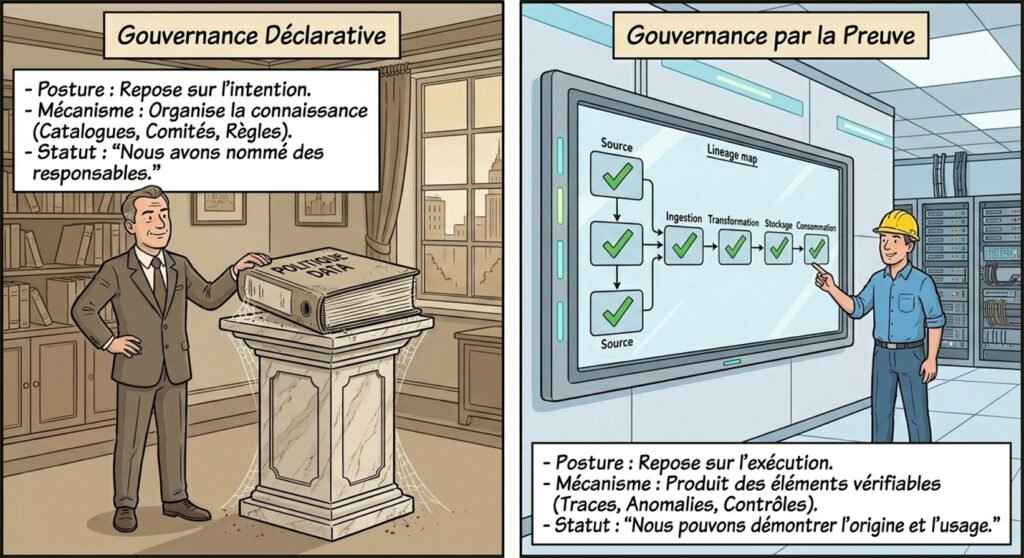
Declarative governance rests essentially on intent. It consists of stating that rules exist, that owners have been appointed and that a framework has been defined.
Governance by proof, by contrast, rests on tangible, verifiable evidence. It demonstrates which data is concerned, which processing is carried out, who is accountable, which controls are performed, which anomalies were detected and which corrective actions were taken.
This shift in paradigm is a major one.
It turns data governance into a fully operational discipline. The goal is no longer simply to organise knowledge about data, but to produce concrete evidence of how it is actually managed across the company.
Data is no longer considered governed because it appears in a catalogue or a repository. It is governed when you can demonstrate its origin, its uses, its quality level, its sensitivity, its lifecycle, the transformations it undergoes, the access rights attached to it and its contribution to business processes.
In this context, proof becomes the indispensable link between data strategy, compliance, cybersecurity, artificial intelligence and operational performance.
AI makes this requirement unavoidable

Artificial intelligence now acts as a particularly demanding revealer of an organisation's data maturity.
Contrary to received wisdom, an AI model does not correct flawed data. It amplifies it.
Incomplete data produces fragile results. Biased data leads to biased decisions. Insufficient traceability limits the ability to explain. Poorly governed data creates legal risk. And outdated information sharply reduces the relevance of any use case.
As companies roll out AI assistants, recommendation engines, predictive models, scoring systems and autonomous agents, one reality asserts itself: you cannot build reliable AI on approximate governance.

The challenge therefore reaches far beyond technology alone.
It becomes, above all, evidential.
To develop responsible and trustworthy AI, organisations must be able to answer fundamental questions: which data feeds the system? Where does it come from? Is it reliable, representative and compliant? Who transformed it? Under which rules? Which controls were applied? What traceability is available?
Without demonstrable answers to these questions, AI becomes a black box fed by data whose control remains uncertain.
Proof becomes a regulatory requirement
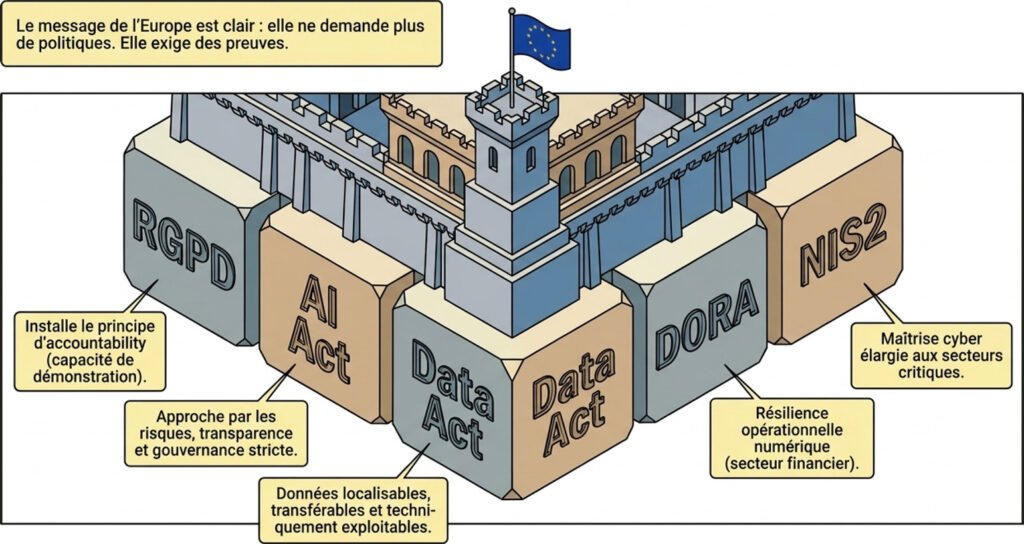
The evolution of the European regulatory framework clearly confirms this trend.
With the GDPR, the accountability principle introduced a major break: organisations must not only comply with the rules on personal data, they must be able to demonstrate that compliance at any moment.
Following the same logic, the AI Act extends this requirement to artificial intelligence, imposing obligations of documentation, transparency, risk management and data governance on the systems concerned.
The Data Act, meanwhile, raises the stakes around data access, sharing, portability and the reversibility of cloud services. To meet these requirements, data must be locatable, qualified and technically usable.
DORA and NIS2, for their part, impose an approach built on the control of digital risk, operational resilience, incident management and the supervision of critical players.
The message to organisations is unambiguous: Europe no longer asks only for policies or procedures. It now demands proof.
Proof: the company's new common language
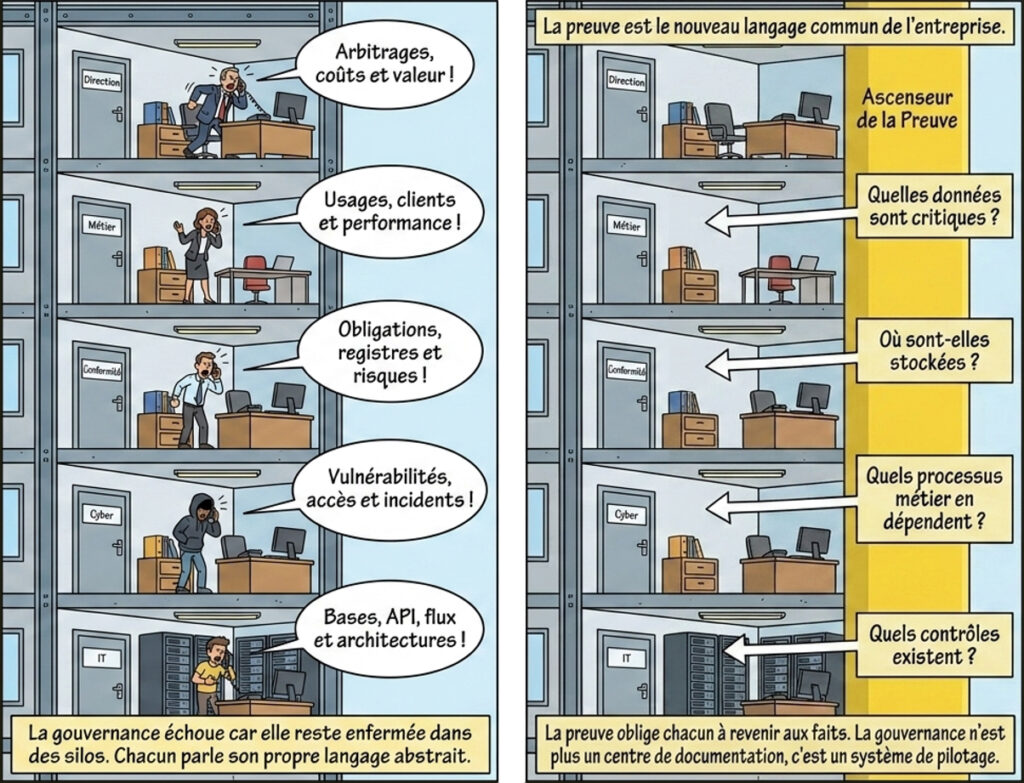
One of the main difficulties in data governance programmes lies in the fragmentation of responsibilities.
- Business teams talk about uses, performance and customer experience.
- IT teams focus on applications, databases, APIs and architecture.
- Compliance functions look at regulatory obligations, risks and controls.
- Cybersecurity experts concentrate on vulnerabilities, access and resilience.
- Executive management arbitrates between value creation, cost control and risk management.
Proof is precisely where these different worlds converge.
Through it, discussions leave the ground of perception for that of verifiable fact: which data is genuinely critical? Where is it stored? Which processing uses it? Which business processes depend on it? Which risks are attached to it? Which controls are in place? Which gaps remain?
In that sense, proof becomes a language shared across the whole organisation.
More than that, it forces every actor to rely on objective evidence rather than declarations.
In the most mature companies, governance then stops being a mere documentation centre and becomes a genuine steering system.
Data must be governed as a resource
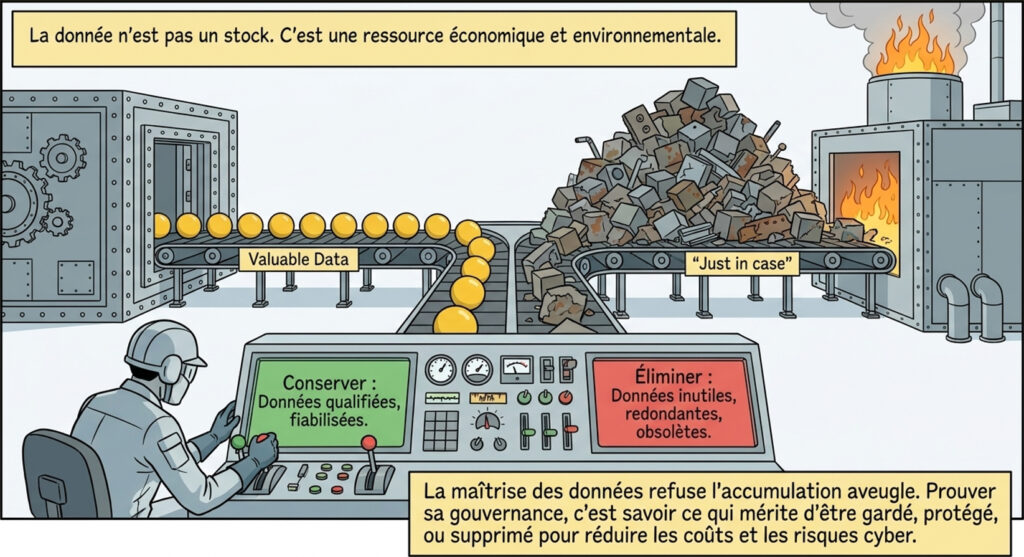
Data is not only a digital asset.
It is at once an economic, regulatory, operational and environmental resource.
Like any strategic resource, it must be identified, qualified, protected, maintained, put to use and, where necessary, deleted.
This is exactly where governance by proof reveals its full value. It allows objective arbitration between the data to keep, to make reliable, to anonymise, to archive, to reuse or to delete.
The approach becomes all the more essential in a context of digital sobriety.
Today, many organisations store considerable volumes of redundant, obsolete or trivial data. This information weighs down infrastructure, drives up costs, complicates migrations, widens the attack surface and undermines artificial intelligence initiatives.
Mastering data therefore does not mean keeping everything “just in case”.
It rests on the ability to determine what genuinely deserves to be kept, for what reason, for how long, in what form and with what level of protection.
Trust is not declared, it is documented
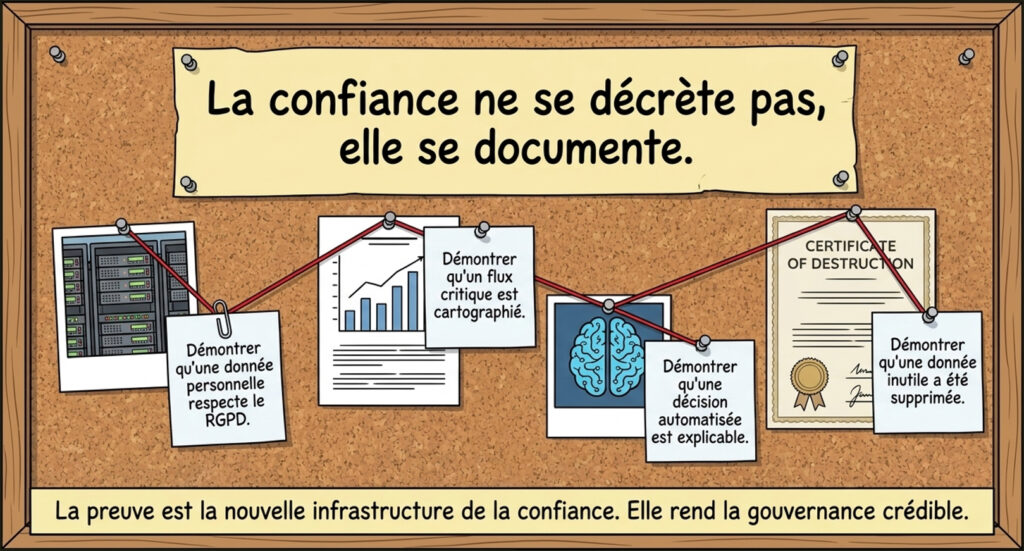
Digital trust now ranks among the strategic priorities of many companies. Yet trust is built neither in a speech nor in a PowerPoint deck.
It rests on the ability to demonstrate.
- To demonstrate that personal data is processed in line with the GDPR.
- To demonstrate that an AI model relies on data under control.
- To demonstrate that a critical flow is mapped.
- To demonstrate that a digital supplier is properly supervised.
- To demonstrate that sensitive data benefits from the necessary protection.
- To demonstrate that an automated decision can be explained.
- To demonstrate that data which became useless has been deleted.
- To demonstrate that an incident can be analysed and traced back.
Proof is thus the new infrastructure of digital trust.
It does not replace governance; it gives it the credibility it needs.
The next competitive advantage will be evidential

In the coming years, organisations will no longer stand out solely by their ability to collect data or deploy artificial intelligence. They will stand out above all by their ability to demonstrate that they genuinely master the data they exploit.
Executive teams must therefore change how they see data governance.
It is neither an administrative topic, nor a mere compliance exercise, nor a documentation project.
It is a strategic capability.
That capability determines the speed of AI projects, the quality of decisions, digital resilience, regulatory compliance, data sovereignty, cost control and stakeholder trust.
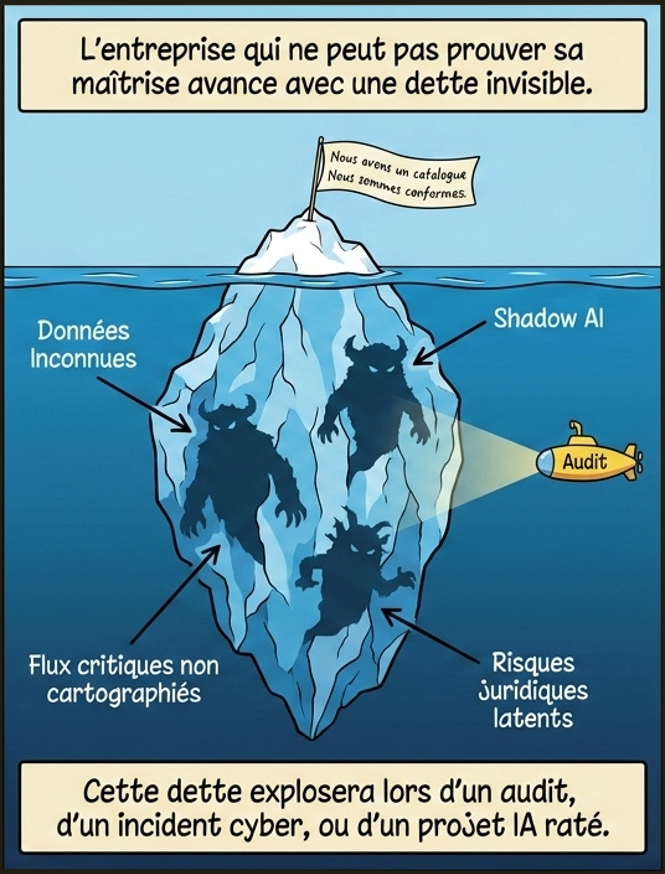
Conversely, an organisation unable to demonstrate control over its information assets accumulates an invisible debt.
Sooner or later, that debt resurfaces: during an audit, a security incident, a complex migration, a regulatory inspection, a dispute, or an AI project that fails to deliver.
Conclusion: to govern is to prove
Data governance is entering a new phase of maturity.
After the era of repositories comes the era of proof. After the era of policies comes the era of verifiable execution. After the era of accumulation comes the era of control.
In a digital environment shaped by artificial intelligence, cybersecurity, regulatory requirements and digital sobriety, cosmetic governance is no longer enough.
Governing data no longer consists solely of naming it, classifying it or documenting it.
To govern data is to be able to demonstrate that it is known, useful, reliable, protected, compliant, traceable and used responsibly.
Because without proof, there is no real governance.
There is only a promise.