Smart territories: the urgent need to recycle your data!
Our article in Archimag issue 352: Information Governance (in French)
Let us not repeat the mistakes of the past!
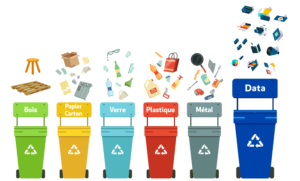
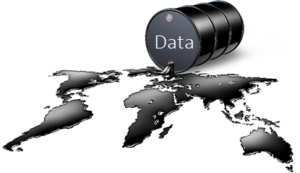
Data is called the new oil of tomorrow, because both raw materials can be monetised through intelligent use — and both have a negative impact on the environment. But unlike oil reserves, which are shrinking, data will keep growing exponentially.
A hundred years ago, to answer a shortage of more durable packaging materials, oil solved the problem through an innovation called “plastic”. Today, the durability we once sought has become a scourge — an estimated 1.8 trillion pieces of waste polluting the oceans.
To avoid repeating the same mistake with oceans of data, we must bring data into a circular economy now — one that shifts the paradigm away from the so-called “linear” economy by limiting the waste of environmental resources and increasing efficiency at every stage of the digital economy. It is urgent to [recycle and control the proliferation and circulation of our data, starting now](/)!
The illusion of dematerialisation
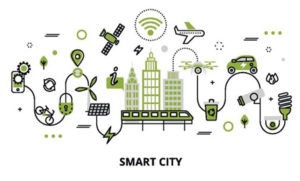
We are entering a new era, that of all-digital. Cloud computing is now a vector of major change in the real world. Data sits at the heart of smart territories: it is a valuable asset for public and private organisations, exchanged in a continuous flow. The hyper-connection of consumers and the hyper-personalisation of services are transforming how we live, learn, work and consume.
Yet the acceleration of the “dematerialisation” of our so-called immaterial economies mechanically increases the number of services available, which in turn increases the need for physical infrastructure — generating enormous effects in the real world that remain imperceptible to the user, who frequently underestimates the physicality, the materiality and the energy impact of the phenomenon.
The storage and energy impact of data centres
Our bulimia of data production and consumption currently translates into compulsive storage, complicating the governance and management of the data lifecycle. It shows up as:
- Collection and production of data for some hypothetical later use;
- Duplication to manage development, integration and delivery quality;
- Massive copies made for various purposes: data warehouse, data lake, experimentation, exploration (artificial intelligence, marketing…);
- Non-selective archiving (with no purge) — no deletion of data that has become useless;
- Backups of every environment including production (one to six times, depending on practice and sector);
- Siloed operations, transfers of data to third parties, and so on;
- Processing run on inactive data…
Infrastructure and technology are currently insufficient to absorb the colossal growth in data. The process of deploying new data centres in France is too long, even slowed down, while digital uses and needs grow and evolve ever faster. Moreover, the measurement of storage impact has not been sufficiently anticipated.
Even though new regulations such as the GDPR encourage awareness of the need to rationalise and delete data whose purpose has been fulfilled, it is more than necessary for all stakeholders in smart territories to build quickly a “right-sized” information estate of quality, in the spirit of data altruism.
The urgency of a new mindset
Contrary to what people think, the digital transition is also one of the drivers of climate disruption, well beyond its ability to prevent it. Its impact will show the steepest increase in our ecological footprint in future, because of the intensified use of data. We must measure and limit the environmental impact of smart territories now, across the digital lifecycle:
- Manufacturing: consumption of rare earths and water; environmental and social damage in extracting countries; significant embodied energy expended.
- Use: energy and land consumption.
- End of life: electronic waste; environmental and social damage in the countries affected by landfill and recycling.
Data is everyone's business. To change the models, we must transform the ways we operate, produce and consume data at scale. To be sustainable, the exploitation of data must incorporate the United Nations Sustainable Development Goals — more specifically SDG 12 on responsible consumption and production, which sets a dedicated target for recycling that it is crucial to apply to data.
Technology has a central role to play in reaching that vital objective, and will have to be used in an eco-responsible way with a logic of digital sovereignty. Establishing suitable governance, transparent and virtuous practices, and engaging stakeholders who are aware and involved will enable the responsible management of the information estate needed to build smart territories.
By 2030, substantially reduce waste generation through prevention, reduction, recycling and reuse.
Recycling is good for the planet and for your budget
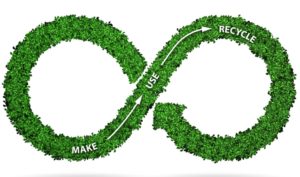
Systnaps DRaaS — Data Recycling as a Service, the first sovereign, eco-responsible and transparent data recycling platform, is an immediate answer to the storage and energy impact of data centres — the cornerstone of our new data-driven economy.
DRaaS equips data centres with a recycling centre whose purpose is to allow data producers to recycle their immaterial “waste” and rationalise their data estate through better governance, selective archiving, reintroduction for new uses and permanent destruction.
As a knock-on effect, it also optimises costs and reduces the capital and operating expenditure tied to the information system.
Systnaps DRaaS answers the pillar that goes unaddressed today — cutting energy and land consumption — making it possible to achieve, depending on context, up to a 50% reduction in the energy footprint.
Join Systnaps DRaaS and the players of the circular economy of data!