From the attention bubble to the prison of language
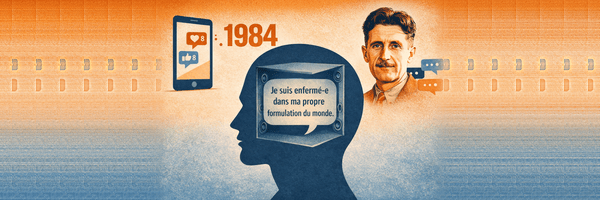
Even when we think we are taking back control, we remain inside a box. It has not disappeared. It has simply changed shape.
For a long time, that box was visible. The echo chamber fed on our clicks, our likes, our scrolling. It showed us what we already wanted to see. Algorithms tailored our world to our past. We could name it, criticise it, sometimes even work around it.
Today, the box has become subtler. It no longer merely filters what we see. It embeds itself in our language. It anticipates what we might want to say. AI systems “converse” with us… but always within the limits of our own words.
The ultimate trap? It is no longer: “I am locked inside my attention bubble.” It is now: “I am locked inside my own way of putting the world into words.”
The better AI gets, the more it confirms us. It rephrases, it smooths, it homogenises. Not out of malice. Out of obedience.
It corrects nothing. It reinforces. In 1984, George Orwell imagined a Newspeak designed to impoverish thought. Today, no Ministry of Truth is needed. Our own language does the work — because it is recycled, scored, predicted… sometimes before it is even thought. That is the point of friction.
What if, without realising it, we were becoming the docile co-authors of our own Newspeak? This is no longer about saying “we are being manipulated”. It is about acknowledging that we ourselves simplify, rephrase and reduce in order to stay readable, likeable, aligned.
A few acts of resistance nonetheless remain possible:
- Next time a tool completes your sentence, do not accept it straight away.
- Next time an AI rephrases you, read yourself out loud.
- Next time a word feels “too complicated”, keep it. It protects you.
Freedom is not lost all at once. It erodes slowly, word after word, choice after choice.
Let us protect what still resists within us: doubt, the detour, the unaligned!
Written by Jawaher Allala — Contact us