Data: pure gold, ordinary — or garbage?
The illusion of digital gold

In today's digital world, data is often compared to gold. That analogy can be misleading. Not all data is equal: some is pure gold — precious and strategic — while some is simply garbage to be discarded.
This illusion of infinite wealth has led many companies to hoard massive quantities of data indiscriminately, believing that value lies in volume. But more is not necessarily better. Without proper management, that accumulation becomes a burden rather than an asset.
The myth of Big Data as treasure
The fascination with Big Data has triggered a race to collect, where every piece of information is stored in the hope that it will one day be useful. Yet this approach overlooks several essential points:
- Quality over quantity: poor-quality or obsolete data leads to flawed analysis and bad strategic decisions.
- Hidden costs: storing and maintaining large volumes of data generates high costs in infrastructure, energy and human resources.
- Increased risk: the larger the volume of data, the greater the exposure in terms of security, compliance and confidentiality.

Understanding the true value of data
To avoid the trap of blind accumulation, it is crucial to understand what gives data its value:
- Relevance: data must be relevant to the company's objectives. Data that is not aligned with strategic needs generates no value.
- Quality: accuracy, reliability and timeliness are essential. Poor-quality data leads to costly mistakes.
- Usability: data must be accessible and usable by those who need it. Data buried in silos or trapped in unusable formats loses its potential value.
- Compliance: respecting regulations on data protection and on the ethics of data and AI is non-negotiable. Non-compliance can trigger financial penalties and a loss of trust.
The dangers of illusory gold
The belief that all data has value leads to counter-productive practices:
- Pointless duplication: excessive copying raises costs without adding value, while multiplying the risk of security breaches.
- Information overload: too much data can overwhelm systems and teams, making it hard to extract actionable insight.
- Decisions based on flawed data: without proper sorting and validation, companies risk deciding on the basis of inaccurate data.
Our mission: making data responsible and circular
At Systnaps, our mission is to respond to the climate emergency and accelerate the convergence of the ecological and digital transitions. We aim to transform data — that unlimited, intangible resource which duplicates endlessly, consumes vast energy and takes up enormous space — by moving it from linear production to a circular economy.
By applying the principles of the circular economy to the data resource through our M4R® method, we seek to reduce environmental impact and maximise the value of data for companies, while guaranteeing data protection and ethics in line with social and regulatory standards.
Get value from your data with the M4R® method
Our innovative Data Recycling® solution
To meet these challenges, we have developed an innovative solution for circular data governance and management, called Data Recycling® and powered by the M4R® method, which makes it possible to:
- Accelerate your Data/AI projects: 40% less time required, ensuring a fast ROI.
- Reduce the carbon footprint: down 40% in the BUILD phase and 15 to 20% in the RUN phase.
- Optimise costs: a significant drop in data-related operating expenditure.
- Strengthen your CSR: an active contribution to the ecological transition and an improved brand image.
A single integrated methodology: M4R®
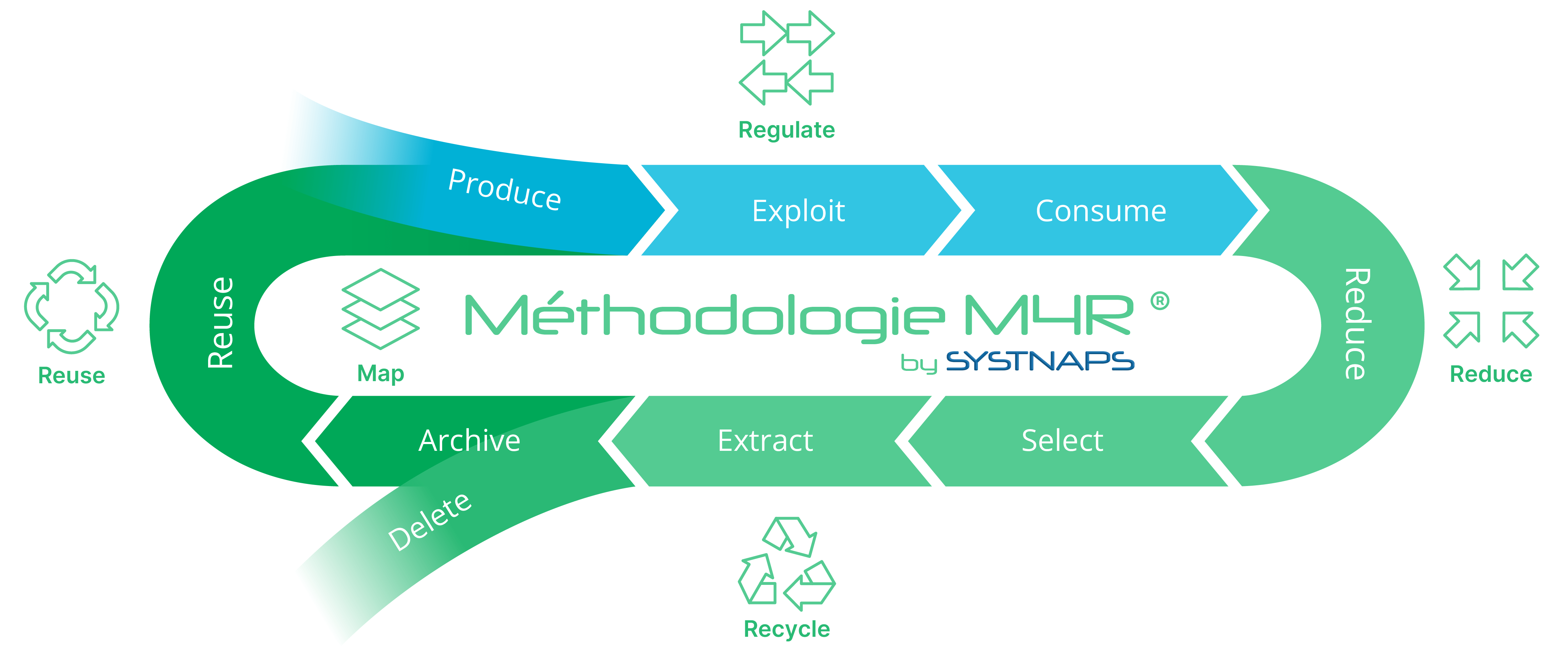
Our M4R® method is a five-step structured approach designed to maximise the value of your data while minimising its environmental impact:
1. Map
Automatically map all of your stored data in under a week. Make it understandable and accessible to gain a clear view of where it lives and how it is used. Organise it efficiently so you can put it to work.
2. Regulate
Ensure your data complies with every applicable standard and regulation (GDPR, Data Act, AI Act) while improving its quality. Reduce legal and operational risk and strengthen stakeholder trust by managing your data ethically, accurately and securely.
3. Reduce
Cut the volume of useless data, such as dark data and ROT data (Redundant, Obsolete, Trivial). Lower the risk of non-compliance as well as the risks tied to personal data protection. This step optimises storage costs and shrinks your environmental footprint.
4. Reuse
Easily reuse and share data under control to avoid re-collection or pointless duplication. Maximise the value of existing data at no extra cost and improve operational efficiency.
5. Recycle
Store unused data in less energy-hungry tiers, or delete it once obsolete. Give data a second life by reassigning it to new purposes. Track its environmental impact throughout its lifecycle.
By adopting the M4R® method, you optimise data management, reduce costs and contribute to a more responsible digital economy.
The belief that all data has value is an illusion that can cost companies dearly. Telling pure gold from digital garbage is essential to getting the most out of your data estate. By adopting a structured approach such as our M4R® method, you can turn your data into a strategic asset while contributing to a more sustainable future.
Our mission is clear: to respond to the climate emergency and accelerate the convergence of the ecological and digital transitions. By applying circular economy principles to data through the M4R® method, we help you get real value from your data estate while reducing your environmental impact.
Together, we can build a strategy suited to your needs and contribute to a more responsible digital economy.
Written by Jawaher Allala
CEO, Systnaps
18/09/2024
For a tailored Data Recycling® demonstration, contact us.