Data governance that acts — and proves

Data Recycling®: the data governance that acts and proves Less noise. Less risk. More performance — and auditable evidence, at last!
The market long confused data governance with governance “on paper”: catalogues, committees, charters, labels.
Yet companies do not have a documentation problem. They have a control problem: what they keep, what they delete, what they protect, what they expose… and how they prove it.
With the explosion of AI use cases, the diagnosis is blunt: if data is not governed through action, AI industrialises the chaos.
Data Recycling® by Systnaps offers a concrete approach: bring the data estate under control, industrialise campaigns (selective archiving, purge, hot/cold, masking/subsetting, quality…), and produce auditable Evidence Packs.
1) The reality on the ground: data is no longer an asset. It is a debt.
Organisations do not just have “a lot of data”. Above all, they have:
- obsolete data (yet still costly),
- uncontrolled copies (BI, exports, tests, data marts),
- pipelines that run “out of habit”,
- sensitive data scattered everywhere,
- and regulatory obligations that keep growing.
If you do not steer the lifecycle, you are funding your own disorder.
2) What has changed: AI does not forgive vagueness
In the past, poorly controlled data was expensive and irritated the teams.
Today, with AI:
- “dirty” data becomes a wrong decision,
- over-exposed data becomes a leak,
- untraceable data becomes a regulatory risk,
- unminimised data becomes an explosion in costs.
AI does not create data problems. It accelerates them.
3) The Data Recycling® promise: to govern is to act
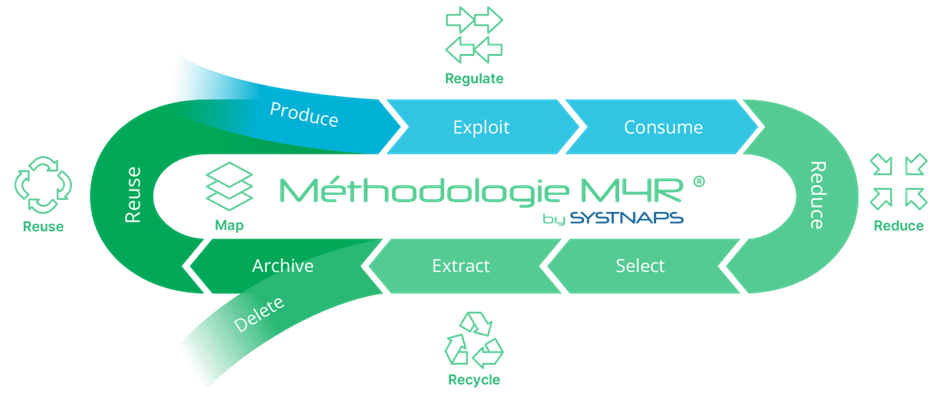
Data Recycling® by Systnaps is governance through execution, structured by M4R:
Map/Model → Regulate → Reduce → Recycle → Reuse
Map / Model (make it intelligible)
We start from business objects and real dependencies: what makes sense, what circulates, what is used, what must be protected.
- Regulate (make it governable)
We turn requirements (GDPR, security, retention…) into actionable rules: who can do what, when, with which approvals.
- Reduce (shrink the “hot data”)
We remove the noise: useless volumes, copies, redundant processing, oversized datasets.
- Recycle (master the lifecycle)
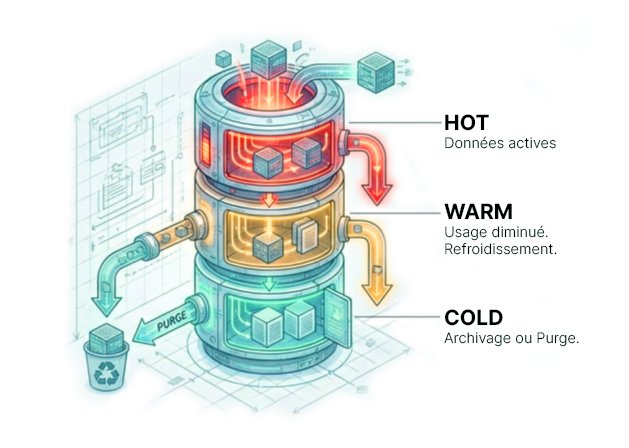
Selective archiving, controlled purge, hot/warm/cold, masking/subsetting: with simulation, workflow and evidence.
- Reuse (make data consumable)
Data products usable for BI/AI without creating risk.
A catalogue describes. Data Recycling® transforms.
“Paper governance” vs “executable governance”
Paper governance
- Catalogue, committees, charters
- “We have defined rules”
- Little execution, little evidence
Executable governance (Data Recycling®)
- Versioned rules + workflows
- Industrialised campaigns (archive/purge/mask…)
- Evidence Packs: traceability, justification, audit-ready
If it is not executable, it is not governable.
4) What the company gets (concrete, measurable)
1) Lower costs (FinOps)
- less hot storage
- less compute (jobs, refreshes, recomputations)
- fewer copies and full-size environments
2) Smaller footprint (GreenOps)
- less pointless processing
- less transfer and duplication
- a sobriety trajectory across the data estate
3) Less risk (GDPR / security / audit)
- reduced attack surface
- controlled retention
- provable purge
- industrialised DSAR (search + extraction + justification)
4) More speed (Ops & data teams)
- more stable pipelines
- a better-performing database
- faster interventions (because they are traceable)
Compliance is not “managed”. It is proven.
The five proofs that change everything (Evidence Pack)
An Evidence Pack is the file that answers:
- Who decided / approved?
- What exactly was done?
- When, and on which scope?
- Why (purpose, legal basis, policy)?
- How (scripts, controls, results, rollback if needed)?
An audit does not want a promise. It wants proof.
5) Telling use cases
Selective archiving of an ERP (Oracle / PeopleSoft / etc.)
- Target a business object (e.g. invoice, order, claim)
- Apply rules (status, closure, dispute, legal deadlines)
- Simulate, obtain approval, execute
- Produce the Evidence Pack and the before/after indicators
Typical result: performance + reduced hot data + lower risk + documented compliance.
Industrialised GDPR DSAR
- multi-source search
- controlled extraction
- masking/purge according to rights
- end-to-end evidence
Masking & subsetting for testing (no wild copies)
- minimised, relevant, compliant datasets
- faster dev/test cycles
- lower leak risk
“Real” test data is a leak waiting to happen.
6) Why it is agent-ready (without the marketing)
Agentic AI is useful if — and only if — it is:
- authorised (rules, roles, separation of duties)
- controlled (approvals, thresholds, dry-run modes)
- observable (traces, costs, successes/failures)
- audited (evidence)
Data Recycling® provides the control plane: actions on data become governed operations, not improvised gestures.
Agentic without proof is just nervous automation.
The four autonomy modes (to secure industrialisation)
- Shadow: observes, recommends, does not act
- Assisted: proposes + mandatory human approval
- Limited: acts within a restricted scope (thresholds + guardrails)
- Full: complete autonomy… but only on reversible, controlled actions
Autonomy is not an ON/OFF switch. It is a controlled trajectory.
7) How to start (without a big bang)
Step 1: pick one to three critical business objects
Those that cost a lot, carry big risk, or block AI.
Step 2: define the rules and the expected evidence
Retention, access, quality, workflows, acceptance criteria.
Step 3: launch a “high-value” campaign
Selective archiving / purge / masking-subsetting / DSAR / hot-cold.
Step 4: measure (FinOps + risk + performance) and industrialise
Move from pilot to portfolio.
Governance is not rolled out. It is proven, one business object at a time.
The promise of Data Recycling® by Systnaps is simple: take back control of the data estate by making governance executable, measurable and audit-ready.
In a context of GDPR, NIS2, DORA, the AI Act, the Data Act, FinOps/GreenOps pressure and AI acceleration, one thing becomes non-negotiable: what cannot be proven will no longer be acceptable.
Is your data estate growing faster than your ability to control it?
Data Recycling® industrialises campaigns (archive/purge/mask) with observability and auditability.