AI in 2026: what really changes, and why
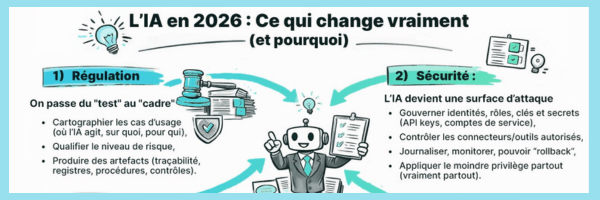
There is a lot of talk about models, performance and benchmarks. On the ground, the reality lies elsewhere.
What we mostly see emerging are four structural shifts that will steer the decisions of CIOs, CDOs and executives from 2026 onward. Shifts that are less spectacular than product announcements, but far more decisive for the durability of organisations.
1. Regulation: from “test” to “framework”
With the AI Act in Europe, and converging initiatives in the United States, the message is clear: AI is no longer an experimental gadget.
It influences people, decisions and critical systems. It must therefore be governed, documented and traceable.
The logic changes: the question is no longer “does it work?” The demand is now for proof:
- transparency,
- risk management,
- demonstrable accountability.
In practice, this means:
- mapping the use cases (where AI acts, on what, for whom),
- qualifying risk levels,
- producing tangible artefacts: registers, procedures, controls, traceability.
AI is entering the field of structured compliance.
2. Security: AI becomes an attack surface
The debate is no longer limited to “AI can get things wrong”. The real issue lies elsewhere. AI is now connected:
- to data,
- to tools,
- to actions (APIs, agents, automations, connectors).
Every connection widens the exposure. And if the foundations — IAM, permissions, cloud configuration — are not solid, the risk explodes.
Concretely, this means:
- governing identities, roles, keys and secrets (API keys, service accounts),
- controlling which connectors and tools are authorised,
- logging, monitoring, and being able to roll back,
- genuinely applying the principle of least privilege.
AI accelerates everything. Including your vulnerabilities.
3. Ethics: trust becomes an asset (and a KPI)
Fatigue with AI washing is palpable: excessive promises → disappointment → loss of trust. In parallel, frameworks are taking shape (UNESCO, international bodies) around clear principles:
- respect for human rights,
- transparency,
- accountability,
- human oversight.
Ethics stops being a talking point. It becomes a lever of credibility. In practice, this requires:
- explaining what the AI does… and what it does not,
- framing sensitive uses (HR, finance, decision-making),
- protecting people against bias, privacy intrusion and manipulation.
Trust cannot be declared. It is built.
4. Technology: from “answering” to “simulating”
Another shift is already under way. AI no longer merely produces answers. It is starting to generate environments: simulation, interaction, scenarios.
Video games are an advanced laboratory for this. But the same logic will spread to many other sectors. Concrete consequences:
- accelerated production chains,
- the emergence of new roles (steering, validation, quality control),
- heightened stakes around intellectual property, traceability and the impact on employment.
This is no longer just about automation. It is about the reconfiguration of processes.
Our conviction
AI does not replace data governance. It makes it indispensable. Without it, what you mostly get is:
- wrong answers,
- delivered faster,
- and better presented.
But still wrong.
What about you?
In your organisation, is the 2026 priority rather:
- compliance,
- security,
- sobriety (FinOps / GreenOps),
- or business transformation?
Written by Jawaher Allala — Contact us